
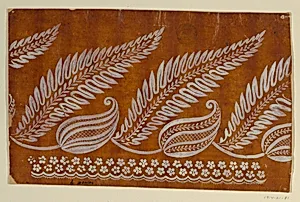
Design for an Embroidered or Woven Horizontal Border of the "Fabrique de St. Ruf," Unfinished, with Alternative Suggestions
1805–1815
Classification
Drawing
Department
Smithsonian Collection
Museum
Smithsonian American Art Museum
Credit
Gift of Eleanor and Sarah Hewitt
Accession Number
1914-21-81
Rights
Public Domain
About this artwork
Research in Progress
Art Historical Context
This unfinished drawing from the Fabrique de Saint Ruf, a renowned textile manufactory in Lyon, France, dates to 1805–1815, the height of the Napoleonic era. Titled *Design for an Embroidered or Woven Horizontal Border*, it features a horizontal pattern with alternative suggestions, showcasing the iterative creative process behind luxury textiles. Lyon, long celebrated as Europe's silk capital, was home to innovative workshops like Saint Ruf, which produced intricate fabrics for fashion and furnishings, blending artisanal skill with emerging industrial techniques. As a preparatory drawing—its medium yet to be fully researched—this piece offers a rare glimpse into 19th-century design practices. Unfinished elements and variants highlight how designers refined motifs to suit embroidery or weaving, ensuring adaptability for looms or needles. During this period, French textiles influenced global tastes, with bold neoclassical patterns symbolizing imperial elegance. Housed in the Smithsonian American Art Museum through the generous gift of Eleanor and Sarah Hewitt, this work underscores the intersection of art and industry. Ongoing research promises to reveal more about its motifs and techniques, inviting us to appreciate the unseen labor behind opulent fabrics.