
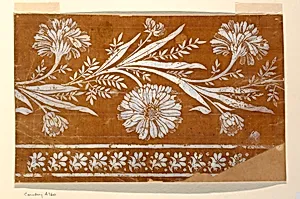
Design for an Embroidered or Woven Horizontal Border of the "Fabrique de St. Ruf"
1815–1815
Medium
Drawing
Classification
Drawing
Department
Smithsonian Collection
Museum
Smithsonian American Art Museum
Credit
Gift of Eleanor and Sarah Hewitt
Accession Number
1914-21-93
Rights
Public Domain
About this artwork
Research in Progress
Art Historical Context
This delicate drawing, titled *Design for an Embro or Woven Horizontal Border the "Fabrique de. Ruf"*, hails from the renowned Fabrique de Saint Ruf in, France, dated to 1815. Created as a preparatory sketch, it served as a blueprint for intricate embroidered or woven textile borders, showcasing the precision and artistry required in high-end fabric production. Now part of the Smithsonian American Art Museum's—thanks to the generous gift of Eleanor and Hewitt—it offers a glimpse into the meticulous world of pattern design. Lyon, the epicenter of France's silk industry during the Napoleonic era and early Restoration period, was famed for its innovative textile workshops like Saint Ruf. In 1815, amid post-war economic recovery, such designs fueled a booming export trade in luxurious furnishings and fashion fabrics. This piece reflects the era's blend of neoclassical elegance and ornamental flair, where borders often featured repeating motifs suited for shawls, curtains, or upholstery. As a simple yet sophisticated drawing, it highlights the unsung role of designers in transforming sketches into tangible luxuries. Though research continues, it invites us to appreciate the craftsmanship bridging art and industry in 19th-century Europe. (198 words)