
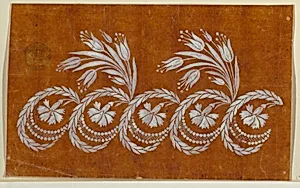
Design for an Embroidered or Woven Horizontal Border of the "Fabrique de St. Ruf"
1805–1815
Classification
Drawing
Department
Smithsonian Collection
Museum
Smithsonian American Art Museum
Credit
Gift of Eleanor and Sarah Hewitt
Accession Number
1914-21-96
Rights
Public Domain
About this artwork
Research in Progress
Art Historical Context
This delicate drawing, titled *Design for an Embro or Woven Horizontal Border the "Fabrique de. Ruf"*, hails from the renowned textile manufactory Fabrique Saint Ruf in Lyon, France, dating to the early 19th century (5–1815). during the Napoleonic Empire era, it represents a preparatory sketch for luxurious fabric trims—likely intended for embroidery or weaving into garments, furnishings, or ribbons. Lyon, long celebrated as the silk capital of Europe, was hub of innovation where designers crafted intricate patterns to meet the era's demand for opulent textiles. As a classified drawing in the Smithsonian American Art Museum's collection—generously gifted by collectors Eleanor and Sarah Hewitt—this piece highlights the collaborative artistry behind textile production. Such designs were essential blueprints, guiding skilled weavers and embroiderers to translate two-dimensional motifs into tactile luxury. Though the exact medium remains unidentified and research continues, it offers a window into France's industrial elegance, blending craftsmanship with the neoclassical influences of the Empire style. Visitors will appreciate how this modest drawing underscores the unseen labor of haute couture's golden age, connecting everyday elegance to Lyon's enduring textile legacy.