
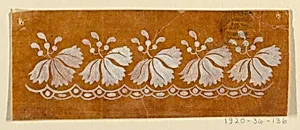
Design for an Embroidered or Woven Horizontal Border of the "Fabrique de St. Ruf"
1805–1815
Medium
Drawing
Classification
Drawing
Department
Smithsonian Collection
Museum
Smithsonian American Art Museum
Credit
Gift of Eleanor and Sarah Hewitt
Accession Number
1920-36-136
Rights
Public Domain
About this artwork
Research in Progress
Art Historical Context
This delicate drawing, titled *Design for an Embro or Woven Horizontal Border of the "Fabrique de. Ruf"*, hails from the renowned silk manufactory Fabrique Saint Ruf in Lyon, France, dating to the early 19th century (1805–1815). Lyon was Europe's silk capital during this era, its workshops producing luxurious textiles that adorned the gowns, furnishings, and interiors of the Napoleonic Empire's elite. As a preparatory design—likely a pattern or cartoon—this ink or pencil work on paper served as a blueprint for weavers and embroiderers, guiding the intricate repetition of motifs in horizontal borders that framed larger fabrics. Created amid the Empire style's neoclassical revival, the piece reflects the period's emphasis on refined elegance and technical precision in textile design. Fabrique de Saint Ruf specialized in high-quality silks, exporting to markets across Europe and America, which underscores the drawing's role in the global trade of decorative arts. Today, preserved in the Smithsonian American Art Museum through the generous gift of Eleanor and Sarah Hewitt, it offers a window into the collaborative craft of design and production that defined French luxury industries. Though research continues, this artifact highlights how such drawings bridged artistry and industry, ensuring harmonious patterns on everything from shawls to upholstery. A testament to Lyon's enduring legacy! (198 words)