
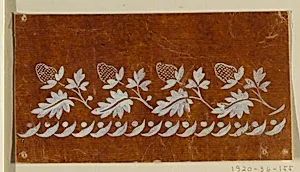
Design for an Embroidered or Woven Horizontal Border of the "Fabrique de St. Ruf"
1805–1815
Classification
Drawing
Department
Smithsonian Collection
Museum
Smithsonian American Art Museum
Credit
Gift of Eleanor and Sarah Hewitt
Accession Number
1920-36-155
Rights
Public Domain
About this artwork
Research in Progress
Art Historical Context
This delicate drawing, titled *Design for an Embro or Woven Horizontal Border the "Fabrique de St. Ruf"*, hails from the renowned silk of Lyon, France, created between 1805 and 1815. Produced by the Fabrique de Saint Ruf prominent textile manufactory in this historic city—the piece is a preparatory sketch intended for embroidery or weaving. Lyon, long celebrated as the silk capital of Europe, thrived during the Napoleonic era, when demand for luxurious fabrics soared for imperial garments, furnishings, and exports. As a classified drawing in the Smithsonian American Art Museum's collection (gift of collectors Eleanor and Sarah Hewitt), it offers a glimpse into the meticulous design process of early 19th-century textile production. Though the exact medium remains unknown, such patterns were essential blueprints for Jacquard looms and skilled artisans, blending neoclassical motifs with the opulent Empire style favored by Napoleon. This artifact underscores Lyon's pivotal role in France's luxury goods industry, bridging fine art and craft. Currently under research, the design invites us to appreciate the unseen labor behind sumptuous silks that adorned Europe's elite, highlighting how innovation in pattern-making fueled global trade and cultural exchange.