
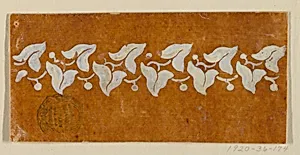
Design for an Embroidered or Woven Horizontal Border of the "Fabrique de St. Ruf"
1800–1815
Classification
Drawing
Department
Smithsonian Collection
Museum
Smithsonian American Art Museum
Credit
Gift of Eleanor and Sarah Hewitt
Accession Number
1920-36-174
Rights
Public Domain
About this artwork
Research in Progress
Art Historical Context
This delicate design drawing from the Fabrique de Ruf in Lyon, France, dates to the early 19th century1800–1815) and served as a blueprint for an embroidered or woven border. Created during the Napoleonic era, it exemplifies the meticulous preparatory work behind luxury textiles, where artists sketched patterns to guide weavers and embroiderers. Though the exact medium remains unidentified, its classification as a drawing highlights the precision required in translating intricate motifs onto fabric. Lyon, long renowned as Europe's silk capital, was home to innovative "fabriques" like Saint Ruf, which produced opulent goods for fashion and furnishings. This period saw a surge in neoclassical-inspired designs, blending classical motifs with Empire style elegance to meet demand from France's elite. Such borders would have adorned shawls, dresses, or upholstery, showcasing the city's mastery of Jacquard weaving techniques that revolutionized pattern complexity. Generously gifted to the Smithsonian American Art Museum by collectors Eleanor and Sarah Hewitt, this piece offers a window into the collaborative artistry of textile design. While research continues, it invites us to appreciate the unseen labor that brought 19th-century splendor to life.