
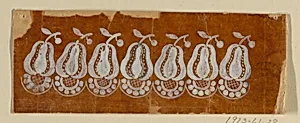
Design for an Embroidery or a Woven Horizontal Border, of the "Fabrique de St. Ruf"
1805-1815
Classification
Drawing
Department
Smithsonian Collection
Museum
Smithsonian American Art Museum
Credit
Smithsonian American Art Museum
Accession Number
1923-61-28
Rights
Public Domain
About this artwork
Research in Progress
Art Historical Context
This delicate drawing, titled *Design for an Embroidery a Woven Horizontal Border from the Fabrique de Saint Ruf in Lyon, France (ca. 1805–1815), offers a glimpse into the golden age of French textile design. Created during the Napoleonic Empire, when Lyon reigned as Europe's silk capital, it served as a blueprint for luxurious embroidered or woven borders—likely intended for garments, furnishings, or ecclesiastical textiles. The Fabrique de Saint Ruf a prominent workshop, exemplified the city's innovative "fabriques," where skilled designers translated intricate patterns into producible weaves, blending artistry with industry. As a classified drawing with an unknown medium, this work highlights the preparatory craft essential to Lyon's silk trade, which employed thousands and supplied imperial courts across Europe. Neoclassical motifs—think scrolling vines, floral garlands, or geometric repeats—would have dominated such designs, reflecting Empire style's grandeur inspired by ancient Rome and Greece. These patterns not only showcased technical prowess in jacquard-like weaving precursors but also symbolized France's economic revival post-Revolution. Though research continues at the Smithsonian American Art Museum, this artifact underscores textiles' role as high art, bridging fine drawing and functional beauty. Imagine it adorning a ball gown or altar cloth, whispering of Lyon's enduring legacy in decorative arts.