
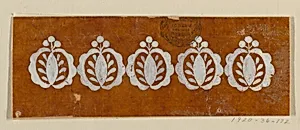
Design for an Embroidered or Woven Horizontal Border of the "Fabrique de St. Ruf"
1800–1815
Classification
Drawing
Department
Smithsonian Collection
Museum
Smithsonian American Art Museum
Credit
Gift of Eleanor and Sarah Hewitt
Accession Number
1920-36-172
Rights
Public Domain
About this artwork
Research in Progress
Art Historical Context
This delicate design drawing hails from the Fabrique de Saint Ruf, a renowned textile workshop in Lyon, France—Europe's silk-weaving capital during the late 18th and early 19th centuries. Created between 1800 and 1815, it served as a blueprint for an embroidered or woven horizontal border, likely intended for luxurious garments, furnishings, or trims. As a preparatory drawing (medium unspecified), it captures the precision required to translate intricate patterns into woven silk or fine embroidery, showcasing the meticulous craftsmanship of Lyon's artisan community. Lyon's silk industry flourished under Napoleonic patronage, producing opulent fabrics that embodied the Empire style's neoclassical elegance—think bold motifs, symmetrical repeats, and refined floral or geometric elements suited for borders. Such designs were vital to the city's economy, fueling fashion exports across Europe and beyond, and reflecting the era's blend of technical innovation and artistic ambition. Today, this piece resides in the Smithsonian American Art Museum's collection, a gift from collectors Eleanor and Sarah Hewitt. With research ongoing, it invites us to ponder the unseen labor behind sumptuous textiles, bridging French design heritage with American museum treasures.