
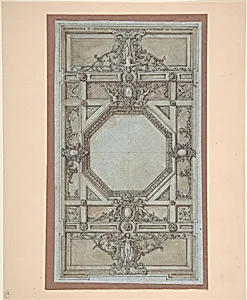
Design for Ceiling Decoration
Medium
Graphite, pen and brown and black ink, brush and brown wash on blue paper.
Dimensions
sheet: 9 1/2 x 5 1/2 in. (24.2 x 13.9 cm)
Classification
Drawings
Department
Drawings and Prints
Museum
Metropolitan Museum of Art, New York, NY
Credit
The Elisha Whittelsey Collection, The Elisha Whittelsey Fund, 1960
Accession Number
60.632.18
Rights
Public Domain
Tags
Art Historical Context
This delicate *Design for Ceiling Decoration*, created anonymously by a French artist in 187, offers a glimpse into the ornate architectural fantasies of 19th-century France. Rendered on blue paper—a favored ground for highlighting light effects—the small sheet (9½ x 5½ inches) captures intricate motifs likely intended for a grand interior ceiling, evoking the opulent Second Empire style popular in Parisian salons and public buildings during Napoleon III's reign. The artwork employs a masterful mix of techniques: graphite for precise underdrawing, pen with brown and black ink for sharp lines, and brush with brown wash for subtle shading and depth. This combination was typical for preparatory studies, allowing artists and architects to refine complex decorative schemes before execution in fresco or stucco. Blue paper enhanced the illusion of airy, luminous spaces, a clever trompe l'œil effect. Housed in the Metropolitan Museum of Art's Drawings and Prints department as part of The Elisha Whittelsey Collection (acquired 1960), this piece highlights the collaborative world of anonymous draftsmen who shaped France's lavish decorative arts. For visitors, it reveals the hidden artistry behind the grandeur of Haussmann-era Paris, inviting imagination about the lavish ceilings it once aspired to adorn.
About the Artist
Anonymous, French, 19th century · 1800–1900
**Anonymous, French, 19th Century (ca. 1800–1900)** The artist cataloged as Anonymous, French, 19th century embodies the enigmatic yet essential contributions of unidentified creators to France's vibrant 19th-century art world. Active roughly between 1800 and 1900, this figure—or potentially collective workshop—produced a diverse array of works amid the nation's transition from Neoclassicism thro...