
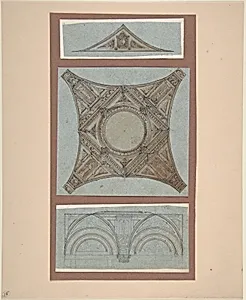
Designs for Decoration of Vaults
ca. 1870
Medium
Graphite, pen and black and brown ink, brush and brown wash on blue paper
Dimensions
sheet: 9 13/16 x 5 3/8 in. (25 x 13.6 cm)
Classification
Drawings
Department
Drawings and Prints
Museum
Metropolitan Museum of Art, New York, NY
Credit
The Elisha Whittelsey Collection, The Elisha Whittelsey Fund, 1960
Accession Number
60.632.19
Rights
Public Domain
Tags
Art Historical Context
This delicate drawing, titled *Designs for Decoration of Vaults comes from an anonymous French artist around 1870, during the opulent Second Empire era in France. Created amid Paris's grand transformations under Baron Haussmann, it the era's passion for lavish architectural ornamentation in public spaces like opera houses and government buildings. Vaults—curved ceilings in grand interiors—were prime canvases for such embellishments, blending neoclassical motifs with emerging eclectic styles. Executed on blue paper with graphite sketches, pen and black and brown inks for precise lines, and brown wash for subtle shading, the work exemplifies 19th-century preparatory techniques. Blue paper provided ideal contrast for these mixed media, allowing artists to visualize light, shadow, and texture in proposed decorations. As a study sheet from the Metropolitan Museum of Art's Elisha Whittelsey Collection, it offers a rare glimpse into the iterative design process behind France's gilded architecture. Though anonymous, this piece highlights the collaborative world of architectural draftsmen, whose innovative patterns influenced the era's enduring legacy of ornate interiors. Visitors can appreciate how such humble sketches paved the way for monumental beauty.
About the Artist
Anonymous, French, 19th century · 1800–1900
**Anonymous, French, 19th Century (ca. 1800–1900)** The artist cataloged as Anonymous, French, 19th century embodies the enigmatic yet essential contributions of unidentified creators to France's vibrant 19th-century art world. Active roughly between 1800 and 1900, this figure—or potentially collective workshop—produced a diverse array of works amid the nation's transition from Neoclassicism thro...