
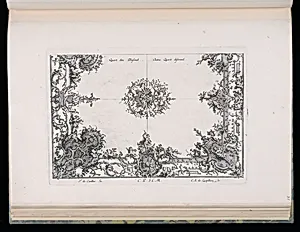
Design for Ceiling Ornament
Classification
Bound print
Department
Smithsonian Collection
Museum
Smithsonian American Art Museum
Credit
Purchased for the Museum by the Advisory Council
Accession Number
1921-6-282-32
Rights
Public Domain
About this artwork
Research in Progress
Art Historical Context
François de Cuvilli the Elder (1695–1768), a Belgian-born architect and who made his mark in Germany, particularly at the Bavarian court in Munich, created this *Design for Ceiling Ornament sometime between 1740 and 1768. Rising from humble origins as a dwarf in the Elector of Bavaria's court, Cuvés became a master of Rococoation, blending French elegance with playful German exuberance. This bound print captures the essence of his innovative designs for lavish interiors, where ceilings served as dramatic canvases for intricate decoration. As a preparatory design in print form, the work exemplifies Rococo's hallmark asymmetry, scrolling motifs, and delicate shell-like forms, which lightened the heaviness of Baroque architecture. Cuvilliés's patterns influenced Europe's elite residences, from palaces like Amalienburg to opera houses, symbolizing the era's fascination with fantasy and refinement amid Enlightenment ideals. Though the exact medium remains unknown and research continues, such prints were vital tools for disseminating designs to craftsmen across workshops. Today, housed in the Smithsonian American Art Museum's collection—purchased by the Advisory Council—this piece invites us to appreciate the artistry behind 18th-century splendor, reminding visitors how a single ceiling could transform a space into a theatrical dreamscape.