
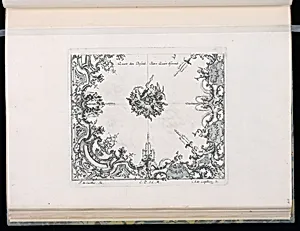
Design for Ceiling Ornament
Classification
Bound print
Department
Smithsonian Collection
Museum
Smithsonian American Art Museum
Credit
Purchased for the Museum by the Advisory Council
Accession Number
1921-6-282-35
Rights
Public Domain
About this artwork
Research in Progress
Art Historical Context
François de Cuvilli the Elder (1695–1768), a Belgian-born architect and who made his mark in Germany, was a master of the exuberant Rococo style. Active at the Bavarian court in Munich, he crafted intricate designs for palaces and interiors that epitomized the era's love for elaborate ornamentation. This *Design for Ceiling Ornament created between 1740 and1768, exemplifies his flair for decorative architecture, likely intended as a blueprint for lavish ceiling decorations in grand European residences. As a bound print from the Smithsonian American Art Museum's collection—purchased by the Advisory Council—this work captures the mid-18th-century shift from Baroque grandeur to Rococo's lighter, more playful asymmetry. Ceiling designs like this often guided artisans in stucco work, gilding, or frescoes, transforming rooms into immersive fantasies of scrolls, shells, and floral motifs. Though research is ongoing and the exact medium remains unidentified, it reflects Cuvilliés's influence on opulent courtly spaces, blending technical precision with whimsical elegance. Visitors will appreciate how such designs brought the heights of palaces to life, inviting the eye upward in a celebration of luxury and imagination. A testament to 18th-century craftsmanship, it bridges art and architecture in the evolving world of interior decoration.