
Discovery Dance, Sac and Fox
1835-1837
Medium
Painting
Classification
Painting
Department
Smithsonian Collection
Museum
Smithsonian American Art Museum
Credit
Smithsonian American Art Museum, Gift of Mrs. Joseph Harrison, Jr.
Accession Number
1985.66.448
Rights
Public Domain
Tags
About this artwork
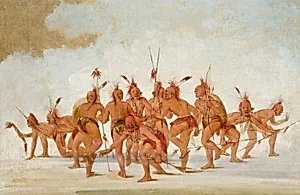
“The Discovery Dance has been given here, amongst various others, and pleased the bystanders very much; it was exceedingly droll and picturesque, and acted out with a great deal of pantomimic effect---without music, or any other noise than the patting of their feet, which all came simultaneously on the ground, in perfect time, whilst they were dancing forward two or four at a time, in a skulking posture, overlooking the country, and professing to announce the approach of animals or enemies which...
Art Historical Context
George Catlin's *Discovery Dance, Sac and Fox (1835–1837) captures a vibrant moment from Native American life on the Great Plains, sketched firsthand during the artist's travels to a Sauk and Fox in 1835. As a pioneering 19th-century painter and ethnographer, Catlin dedicated his career to documenting Indigenous cultures threatened by westward expansion, creating realistic oil paintings that preserve rituals, portraits, and daily scenes with meticulous detail. This work exemplifies his commitment to authenticity, blending artistic skill with anthropological observation. In the painting, Sauk and Fox men perform a lively "Discovery Dance," advancing in a skulking posture while rhythmically patting their feet in perfect unison—no music, just the earthy beat echoing their steps. As Catlin described, dancers mimic scouts signaling the approach of animals or enemies, relaying messages back to the leader in a pantomimic display that's both droll and picturesque. This ritual highlights the tribe's communal storytelling and vigilance, offering visitors a window into pre-reservation traditions. Housed in the Smithsonian American Art Museum, this piece underscores Catlin's enduring legacy in American art, reminding us of the cultural richness he fought to immortalize before it faded.
About the Artist
George Catlin · 1796–1872
George Catlin (1796–1872), born in Wilkes-Barre, Pennsylvania, to Putnam Catlin and Polly Sutton—who had been captured by Native Americans during the 1778 Battle of Wyoming—initially pursued a legal career. Trained at Litchfield Law School, he was admitted to the bar in 1819 but abandoned law after two years to study art in Philadelphia in 1823. Self-taught as a portraitist, Catlin quickly gained ...