
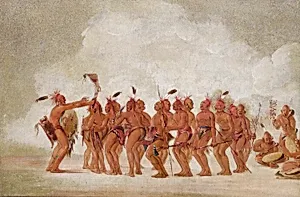
Slave Dance, Sac and Fox
1835-1837
Medium
Painting
Classification
Painting
Department
Smithsonian Collection
Museum
Smithsonian American Art Museum
Credit
Smithsonian American Art Museum, Gift of Mrs. Joseph Harrison, Jr.
Accession Number
1985.66.450
Rights
Public Domain
Tags
About this artwork
“The slave-dance is a picturesque scene, and the custom in which it is founded a very curious one. This tribe has a society which they call the ‘slaves’ composed of a number of the young men of the best families in the tribe, who volunteer to be slaves for the term of two years, and subject to perform any menial service that the chief may order, no matter how humiliating or how degrading it may be; by which, after serving their two years, they are exempt for the rest of their lives, on war-parti...
Art Historical Context
George Catlin's *Slave Dance, Sac and* (1835–1837) captures a fascinating ritual among the Sac and Fox (Sauk and Fox) people, a Native American tribe from the Midwest. Painted during Catlin's extensive travels among Indigenous communities in the 1830s, this oil painting stems from sketches he made at a Sac and Fox village in 1835. As a pioneering artist and ethnographer, Catlin sought to document Native customs before they were eroded by European-American expansion, creating vivid, realistic portrayals that blend portraiture with cultural observation—hallmarks of his signature style. The scene depicts the "slave-dance," a ceremonial tradition described by Catlin himself. Young men from the tribe's finest families voluntarily served as "slaves" for two years, performing any menial tasks ordered by their chief, no matter how humbling. They elected one of their own as master, obeying his commands implicitly. This service granted them lifelong exemption from labor like cooking or camp duties. The dance preceded their annual feast, symbolizing camaraderie, discipline, and social honor in Sac and Fox society. Housed in the Smithsonian American Art Museum, this work highlights the tribe's unique societal structure and Catlin's urgent mission to preserve vanishing traditions amid 19th-century upheaval. It's a window into Indigenous resilience and complexity, inviting us to appreciate cultures often misunderstood.
About the Artist
George Catlin · 1796–1872
George Catlin (1796–1872), born in Wilkes-Barre, Pennsylvania, to Putnam Catlin and Polly Sutton—who had been captured by Native Americans during the 1778 Battle of Wyoming—initially pursued a legal career. Trained at Litchfield Law School, he was admitted to the bar in 1819 but abandoned law after two years to study art in Philadelphia in 1823. Self-taught as a portraitist, Catlin quickly gained ...