
Medium
Hard-paste porcelain
Dimensions
1 3/4 × 5 1/8 in. (4.4 × 13 cm)
Classification
Ceramics-Porcelain
Culture
Austrian, Vienna with German, Breslau (Wrocław) decoration
Department
European Sculpture and Decorative Arts
Museum
Metropolitan Museum of Art, New York, NY
Credit
Gift of R. Thornton Wilson, in memory of Florence Ellsworth Wilson, 1943
Accession Number
43.100.40
Rights
Public Domain
Tags
Art Historical Context
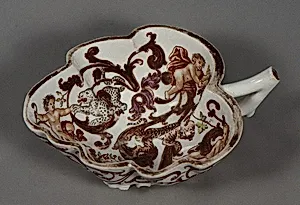
This delicate dish, crafted around 1725–30 during the pioneering Claudius Innocentius du Paquier period at Vienna's first porcelain manufactory, exemplifies early European mastery of hard-paste porcelain Founded in 1718 by du Pa, the factory was Austria's bold response to Meissen's dominance, producing translucent, durable porcelain fired at high temperatures—a closely guarded Chinese secret that Europeans had only recently unlocked. Painter Ignaz Bottengr contributed the vibrant decorations, applied in Breslau (modern Wrocław), highlighting a collaborative network across Central Europe. Measuring just 1¾ × 5⅛ inches, the dish features playful putti—chubby, winged cherubs—frolicking amid leopards and tigers, blending Rococo whimsy with exotic motifs inspired by Asian imports and European fantasy. These lively scenes on the glossy white ground showcase intricate overglaze enameling techniques, where colors like vivid blues, golds, and earthy tones were fired to create lasting sheen. Such pieces were prized by aristocracy for their rarity and technical virtuosity. A gift to The Metropolitan Museum of Art in 1943, this dish offers a window into 18th-century luxury and innovation, when porcelain symbolized cultural prestige and artistic ambition.