
Dish
Unknown Artist
17th century
Medium
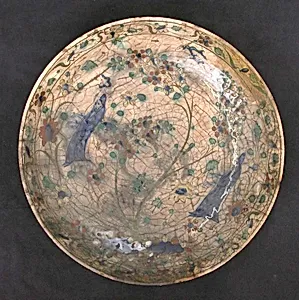
Stonepaste; underglaze painted in black, blue, and green with red and yellow slips
Dimensions
H. 3 in. (7.6 cm) Diam. 15 1/8 in. (38.4 cm)
Classification
Ceramics
Department
Islamic Art
Museum
Metropolitan Museum of Art, New York, NY
Credit
Mr. and Mrs. Isaac D. Fletcher Collection, Bequest of Isaac D. Fletcher, 1917
Accession Number
17.120.60
Rights
Public Domain
Tags
Art Historical Context
This elegant 17th-century dish, crafted from stonepaste—a durable, vitreous ceramic body prized in Islamic pottery traditions—exemplifies the technical mastery of potters in the Middle East, likely from regions like Iran or Turkey. Measuring a generous 15⅛ inches in diameter and just 3 inches high, its shallow form was ideal for serving fruits, sweets, or communal meals, reflecting the hospitality central to Islamic culture. The underglaze painting in black, blue, and green, accented by vibrant red and yellow slips, creates a luminous effect once fired under a transparent glaze, a sophisticated technique that ensured colorfastness and sheen. The dish's motifs—blooming flowers, lush leaves, and graceful human figures—evoke the natural world and poetic narratives beloved in Persian and Ottoman art. These designs, often drawn from gardens symbolizing paradise, blend stylized flora with lively figures in a harmonious composition, showcasing the era's fusion of realism and abstraction. Part of the Metropolitan Museum of Art's Islamic Art collection, gifted through the Isaac D. Fletcher bequest in 1917, this piece highlights the global reach of Islamic ceramics, which influenced European porcelain makers centuries later. (198 words)