
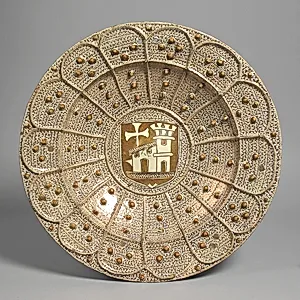
Dish with Unidentified Coat of Arms
Unknown Artist
1470–90
Medium
Tin-glazed earthenware
Dimensions
Overall: 17 3/4 in. (45.1 cm)
Classification
Ceramics
Culture
Spanish
Department
The Cloisters
Museum
Metropolitan Museum of Art, New York, NY
Credit
The Cloisters Collection, 1956
Accession Number
56.171.107
Rights
Public Domain
Tags
About this artwork
This ceramics from Spanish, dating to 1470–90, provides valuable insight into the artistic practices and material culture of its era. Created in tin-glazed earthenware, this work embodies the material practices and technical knowledge of its era. Artists' choices of materials reflected both practical availability and symbolic associations, with different media carrying distinct cultural meanings and artistic possibilities. Understanding historical techniques and materials enriches our appreciati...
Art Historical Context
This elegant dish, crafted in Spanish tin-glazed earthenware 1470 and 1490, exemplifies the vibrant ceramic traditions of late medieval Spain. Measuring nearly 18 inches across, it features an unidentified coat of at its center—a heraldic emblem likely commissioned for a noble family or institution, symbolizing lineage, status, and pride The tin glaze, a technique yielding a luminous, white surface ideal for vivid painted decoration, reflects the era's advanced material knowledge, blending practical durability with artistic flair. Such wares were prized for both everyday use and display in affluent households. As an anonymous work from a workshop tradition, the dish offers a window into collective Spanish artistic practices, where regional styles and technical innovations thrived without individual signatures. Influenced by Islamic ceramic expertise from earlier centuries, tin-glazed earthenware like this bridged cultural exchanges in Iberia, carrying symbolic meanings tied to identity and heritage. Preserved in The Cloisters collection at The Metropolitan Museum of Art since 1956, it enriches our understanding of 15th-century visual culture, revealing how everyday objects encoded social hierarchies and aesthetic values for modern visitors to admire.