
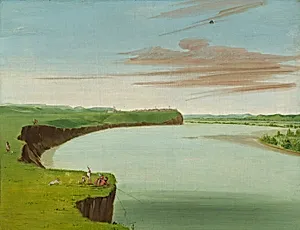
Distant View of the Mandan Village
1832
Medium
Painting
Classification
Painting
Department
Smithsonian Collection
Museum
Smithsonian American Art Museum
Credit
Smithsonian American Art Museum, Gift of Mrs. Joseph Harrison, Jr.
Accession Number
1985.66.379
Rights
Public Domain
Tags
About this artwork
The Mandan village near Fort Clark in present-day North Dakota was a hub of commerce where agricultural products and manufactured goods obtained from whites were traded for furs, horses, and other commodities with Plains tribes. Though Catlin described them as “entirely in a state of primitive wildness,” the Mandan had been in direct recorded contact with Europeans since the 1730s; French and Spanish trade goods had reached them even earlier. Lewis and Clark spent the winter of 1804--05 with the...
Art Historical Context
George Catlin's *Distant View of thean Village* (1832) captures a panoramic scene of the Mandan settlement near Fort Clark in present-day North Dakota. As a pioneering American artist, Catlin traveled the Great Plains in the early 1830s to Native American life through hundreds of portraits and landscapes, driven by a mission to preserve vanishing cultures before Western expansion altered them forever. This oil painting exemplifies his realistic style, blending Romantic idealism with ethnographic detail to evoke the vastness of the American frontier. The Mandan village was a vibrant hub of commerce, where agricultural goods and European trade items—reached via French and Spanish networks since before the 1730s—were exchanged for furs, horses, and commodities with Plains tribes. Despite Catlin's portrayal of them in "primitive wildness," the Mandan had deep ties to outsiders: Lewis and Clark wintered there in 1804–05, and Chief Sheheke even visited Washington, D.C., in 1806. Featuring elements like teepees along the river and distant figures, the work highlights the Mandan's earth-lodge architecture and strategic riverside location, offering visitors a window into a dynamic Indigenous world on the cusp of profound change.
About the Artist
George Catlin · 1796–1872
George Catlin (1796–1872), born in Wilkes-Barre, Pennsylvania, to Putnam Catlin and Polly Sutton—who had been captured by Native Americans during the 1778 Battle of Wyoming—initially pursued a legal career. Trained at Litchfield Law School, he was admitted to the bar in 1819 but abandoned law after two years to study art in Philadelphia in 1823. Self-taught as a portraitist, Catlin quickly gained ...