
永田友治作 紫陽花蝶蒔絵料紙箱|Document Box (Ryōshibako) with Hydrangeas and Butterflies
early 18th century
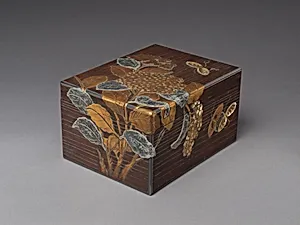
Medium
Lacquered wood with gold takamaki-e and hiramaki-e, and mother-of-pearl and pewter inlay
Dimensions
H. 6 in. (15.2 cm); W. 8 1/4 in. (21 cm); L. 10 3/4 in. (27.3 cm)
Classification
Lacquer
Culture & Period
Japan · Edo period (1615–1868)
Department
Asian Art
Museum
Metropolitan Museum of Art, New York, NY
Credit
The Howard Mansfield Collection, Purchase, Rogers Fund, 1936
Accession Number
36.100.147a, b
Rights
Public Domain
Tags
Art Historical Context
This exquisite *Document Box (Ryōshibako) with Hydrangeas Butterflies* by Nagata Yūji to the early 18 century, during Japan's Edo period (1615–1868), a time of peace and artistic refinement. Crafted as a practical storage container for papers and scrolls, its modest dimensions—about 6 inches high, 8¼ inches wide, and 10¾ inches long—belie its luxurious design, transforming an everyday object into a masterpiece of Japanese lacquerwareNagata employs sophisticated maki-e techniques: *takamaki-e* for raised, gold-powdered motifs that create a tactile, three-dimensional glow, and *hiramaki-e* for flatter, shimmering surfaces. Delicate inlays of iridescent mother-of-pearl and gleaming pewter enhance the hydrangea blossoms and butterflies, evoking summer gardens alive with fleeting beauty. Hydrangeas symbolize resilience in Japanese culture, while butterflies represent transformation—perfect emblems of Edo-era elegance. Acquired through The Howard Mansfield Collection and now in the Metropolitan Museum of Art's Asian Art department, this box exemplifies lacquer's pinnacle in Edo Japan, where artisans like Nagata catered to samurai and merchants with opulent yet functional art. Visitors, imagine its subtle luster under lantern light, a testament to enduring craftsmanship.
About the Artist
Nagata Yūji · 1711–1736
Nagata Yūji was a Kyoto-based master of makie lacquerware, active during the Shōtoku (1711–1716) and Kyōhō (1716–1736) eras of Japan's Edo period. Little is known of his early life, which remains sparsely documented, though he later moved to Edo and pursued interests as a tea master. Yūji signed his works—a rarity among lacquer artists of the time—under pseudonyms like Seiseishi (青々子, "child of Se...