
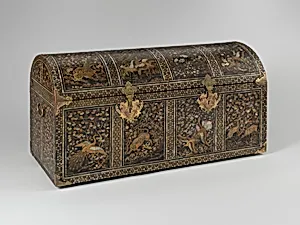
花鳥獣蒔絵螺鈿洋櫃|Nanban Coffer with Animals and Landscapes
Unknown Artist
late 16th–early 17th century
Medium
Lacquered wood with gold and silver hiramaki-e and mother-of-pearl inlay
Dimensions
H. 25 in. (63.5 cm); W. 49 3/16 in. (125 cm); D. 21 7/16 in. (54.5 cm)
Classification
Lacquer
Culture & Period
Japan · Momoyama period (1573–1615)
Department
Asian Art
Museum
Metropolitan Museum of Art, New York, NY
Credit
Purchase, John and Pauline Gandel Gift and Mary Livingston Griggs and Mary Griggs Burke Foundation Fund, 2016
Accession Number
2016.508
Rights
Public Domain
Tags
Art Historical Context
This exquisite *Nanban Coffer with Animals and Landscapes* (花鳥獣蒔絵螺鈿洋櫃) hails from Japan's Momoyama period (1573–1615), a time of bold artistic expression and cultural exchange. Crafted in the late 16th to early 17th century, this large lacquered wooden chest—measuring over four feet wide—served as a luxurious storage coffer, likely inspired by European designs introduced via Portuguese traders, hence the "Nanban" (Southern Barbarian) designation. Its grand scale and opulent decoration reflect the era's fascination with splendor, amid samurai warfare and emerging global trade. The coffin's surface dazzles with intricate hiramaki-e, a flat lacquer technique where fine gold and silver powders are sprinkled onto wet lacquer for a shimmering effect, combined with raden—delicate mother-of-pearl inlays cut from abalone shells. Vivid scenes of peacocks, deer, tigers, and birds amid lush landscapes evoke the natural world's harmony and ferocity, showcasing Japanese mastery of lacquerware, one of the country's most revered crafts since ancient times. Historically, such pieces symbolized wealth and sophistication, bridging Japanese tradition with exotic influences during the Nanban trade boom. Now at The Metropolitan Museum of Art, thanks to generous gifts, it invites us to marvel at Momoyama's lavish legacy.