
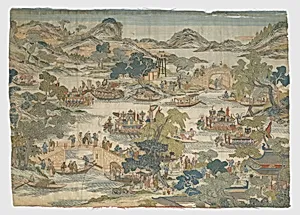
清 緙絲龍舟競渡圖|Dragon-boat festival performance
18th–19th century
Medium
Silk and metal thread tapestry (kesi)
Dimensions
30 × 42 1/2 in. (76.2 × 108 cm) Pressure-mounted: 35 × 47 × 1 1/2 in. (88.9 × 119.4 × 3.8 cm)
Classification
Paintings
Culture & Period
China · Qing dynasty (1644–1911)
Department
Asian Art
Museum
Metropolitan Museum of Art, New York, NY
Credit
Bequest of Alice E. Getty, 1949
Accession Number
49.47
Rights
Public Domain
Tags
Art Historical Context
This vibrant silk and metal-thread tapestry, known as *Dragon-Boat Festival Performance* (清 緙絲龍舟競渡圖), captures exhilarating energy of China's traditional Dragon Boat Festival during the Qing dynasty (1644–1911). by an unidentified artist in the 18th–19th century, work measures 30 × 42½ inches and depicts a lively riverside scene alive with racing dragon boats, arched bridges, and cheering crowds amid picturesque landscapes. These festivals, held annually on the fifth day of the fifth lunar month, commemorate the poet Qu Yuan and feature competitive boat races symbolizing communal harmony and warding off evil spirits. The medium, kesi—a prestigious discontinuous weft-weaving technique—highlights the Qing era's mastery of textiles. Threads of silk and metallic filaments are meticulously woven to form intricate, almost painterly details without underlying drawings, mimicking the precision of brushwork in imperial workshops. Often produced for elite patrons, such tapestries blended functionality with artistry, serving as wall hangings or ceremonial displays. Bequeathed to the Metropolitan Museum of Art in 1949 by Alice E. Getty, this piece offers a window into Qing cultural life, where festivals fused sport, mythology, and spectacle, inviting visitors to feel the rhythmic pulse of oars and the roar of the crowd.