
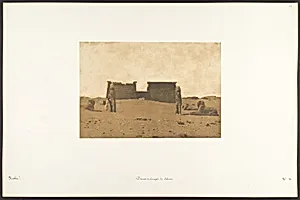
Dromos du Temple de Séboua
April 3, 1850
Medium
Salted paper print from paper negative
Dimensions
Image: 6 1/8 × 8 15/16 in. (15.5 × 22.7 cm) Image: 8 7/8 × 6 9/16 in. (22.5 × 16.7 cm) Mount: 18 11/16 × 12 5/16 in. (47.5 × 31.2 cm) Frame: 16 x 20 in. (40.6 x 50.8 cm)
Classification
Photographs
Department
Photographs
Museum
Metropolitan Museum of Art, New York, NY
Credit
Gilman Collection, Gift of The Howard Gilman Foundation, 2005
Accession Number
2005.100.376.136
Rights
Public Domain
Tags
Art Historical Context
**Dromos du Temple de Séa**, captured by Maxime Du Camp on 3, 1850, offers a mesmerizing glimpse into the grandeur of ancient Nubian architecture This salted paper print from paper negative depicts the d—the monumental avenue lined withinxes—leading to the Temple of Séboua in southern Egypt. Built during the Ptolemaic and dedicated to Ramesses II, temple's ruins evoke the enduring legacy of pharaonic power amid the desert sands. Du Camp, a pioneering French photographer and travel writer, documented this scene during his 1849–1850 expedition through Egypt and Nubia alongside Gustave Flaubert. His work marked one of the earliest photographic surveys of Egyptian antiquities, predating grander missions like those of the Egypt Exploration Fund. Published in his groundbreaking 1852 album *Egypte, Nubie, Palestine et Syrie*, these images brought distant wonders to European audiences, fueling Egyptomania and scholarly interest. The salted paper process, an early calotype technique, yields the print's soft, atmospheric tones and subtle details, highlighting the medium's role in preserving fragile ruins. From the Metropolitan Museum of Art's Gilman Collection, this 6⅛ × 8⅞ in. photograph bridges 19th-century exploration with timeless cultural heritage, inviting us to trace the footsteps of ancient pilgrims.
About the Artist
Maxime Du Camp · 1822–present
Maxime Du Camp (1822–1894) was a pioneering French photographer and writer whose adventurous spirit and technical innovation bridged literature and visual art during the mid-19th century. Born in Paris on February 8, 1822, to a prosperous family—his father a successful surgeon—Du Camp received a solid bourgeois education at the Collège Bourbon (now Lycée Condorcet), where he cultivated interests i...