
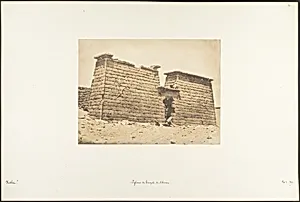
Pylones du Temple de Sébona
April 3, 1850
Medium
Salted paper print from paper negative
Dimensions
Image: 6 1/2 × 8 3/4 in. (16.5 × 22.3 cm) Image: 8 7/8 × 6 9/16 in. (22.5 × 16.7 cm) Mount: 18 11/16 × 12 5/16 in. (47.5 × 31.2 cm)
Classification
Photographs
Department
Photographs
Museum
Metropolitan Museum of Art, New York, NY
Credit
Gilman Collection, Gift of The Howard Gilman Foundation, 2005
Accession Number
2005.100.376.137
Rights
Public Domain
Tags
Art Historical Context
Step into the sun-baked sands of ancient Egypt with *Pylones du Temple Sébona*, a captivating salted paper print by Maxime Du Camp, captured April 3, 1850. This image showcases the towering pylons of Temple of Sebenytos (modern Sebenu), majestic ruins that whisper tales of pharaonic grandeur amid columns and weathered stone. Du Camp, a pioneering French photographer and writer, documented these architectural marvels during his 1849–1851 travels through Egypt and the Near East, often alongside his friend Gustave Flaubert. Printed from a paper negative using the calotype process—a breakthrough technique invented by William Henry Fox Talbot—this medium lent Du Camp's work a soft, textured quality, evoking the dreamlike haze of distant antiquity. Unlike sharp daguerreotypes, calotypes allowed multiple prints from a single negative, making them ideal for sharing exotic discoveries with eager European audiences. Housed in the Metropolitan Museum of Art's Gilman Collection, this photograph holds immense historical significance as one of the earliest visual records of Egyptian temples. Published in Du Camp's groundbreaking 1852 book *Egypte, Nubie, Palestine et Syrie*—the first photo-illustrated travelogue—it fueled 19th-century Egyptomania, bridging ancient wonders with modern eyes and cementing photography's role in preserving cultural heritage.
About the Artist
Maxime Du Camp · 1822–present
Maxime Du Camp (1822–1894) was a pioneering French photographer and writer whose adventurous spirit and technical innovation bridged literature and visual art during the mid-19th century. Born in Paris on February 8, 1822, to a prosperous family—his father a successful surgeon—Du Camp received a solid bourgeois education at the Collège Bourbon (now Lycée Condorcet), where he cultivated interests i...