
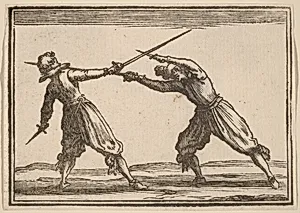
Duel with Swords and Daggers
Medium
woodcut on laid paper
Dimensions
sheet (trimmed to block): 6 × 8.3 cm (2 3/8 × 3 1/4 in.)
Classification
Department
CG-E
Museum
National Gallery of Art, Washington, D.C.
Credit
R.L. Baumfeld Collection
Accession Number
1969.15.222
Rights
Public Domain
Art Historical Context
**Duel with Swords and Daggers** (1621) is a dynamic woodcut on laid paper by Edouard Eckman, faithfully reproducing a design by the renowned French printmaker Jacques Callot. Measuring just 6 × 8.3 cm, this intimate print captures the raw intensity of a close-quarters duel, with swords and daggers clashing in a whirlwind of motion. Callot, a master of the early Baroque era, was celebrated for his intricate depictions of human drama, from festivals to battles, and this work exemplifies his ability to pack vivid storytelling into miniature formats. Created during a time when dueling was a ritualized code of honor among European nobility—often sparked by slights to reputation or love—this print reflects the martial culture of 17th-century France and Italy, where Callot worked extensively. Woodcuts like this one were relief prints carved into wood blocks, ideal for producing affordable, multiple impressions on laid paper (notable for its textured chain lines), making high art accessible beyond elite circles. From the R.L. Baumfeld Collection at the National Gallery of Art, this piece highlights Callot's enduring influence on printmaking techniques, blending fine detail with explosive energy. It's a window into an era of chivalry and violence, reminding us how art immortalizes fleeting, perilous moments.
About the Artist
Edouard Eckman after Jacques Callot
Edouard Eckman, a Flemish printmaker born around 1600, remains a somewhat enigmatic figure in art history, with his early life not well documented. Little is known about his training or formal education, though his oeuvre suggests familiarity with the vibrant printmaking traditions of the early Baroque period in Northern Europe. Active primarily in the second decade of the seventeenth century, Eck...