
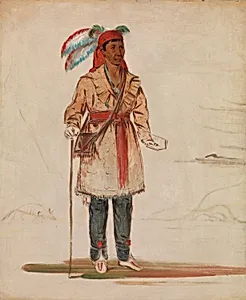
Ee-tów-o-kaum, Both Sides of the River, Chief of the Tribe
1836
Medium
Painting
Classification
Painting
Department
Smithsonian Collection
Museum
Smithsonian American Art Museum
Credit
Smithsonian American Art Museum, Gift of Mrs. Joseph Harrison, Jr.
Accession Number
1985.66.272
Rights
Public Domain
Tags
About this artwork
George Catlin probably painted Ee-tów-o-kaum, chief of the Mahican tribe, at Green Bay (in today’s Wisconsin) in 1836. In Letters and Notes, his extensive writings on his travels and visits to Native American tribes across the West, Catlin described the Mahican as a “once powerful and still famous tribe, residing . . . in the territory of Wisconsin,” where they settled after leaving New York in 1833. He painted the chief at “full length, with a psalm-book in one hand, and a cane in the other . ....
Art Historical Context
George Catlin's 1836 portrait, *Ee-tów-o-kaum, Both of the River, Chief the Tribe*, captures theican leader at Green Bay, Wisconsin, the artist's ambitious travels to document Native American life. Catlin, a pioneering 19th-century painter, created over 600 portraits and landscapes to preserve Indigenous cultures amid rapid U.S. expansion. The Mahican, once a powerful New York-based tribe, had relocated to Wisconsin's Stockbridge area just three years earlier, highlighting the forced migrations of the era. Painted at full length, Ee-tów-o-kaum holds a psalm-book in one hand and a cane in the other, symbols of his shrewd intelligence and sincere Christian faith, as Catlin noted in his *Letters and Notes*. This blend of tradition and adaptation reflects the chief's navigation of cultural change. Catlin's realistic style—rooted in oil on canvas—emphasizes dignity and individuality, making this Smithsonian treasure a poignant window into Mahican resilience and the artist's urgent mission to record a vanishing world before assimilation took hold.
About the Artist
George Catlin · 1796–1872
George Catlin (1796–1872), born in Wilkes-Barre, Pennsylvania, to Putnam Catlin and Polly Sutton—who had been captured by Native Americans during the 1778 Battle of Wyoming—initially pursued a legal career. Trained at Litchfield Law School, he was admitted to the bar in 1819 but abandoned law after two years to study art in Philadelphia in 1823. Self-taught as a portraitist, Catlin quickly gained ...