
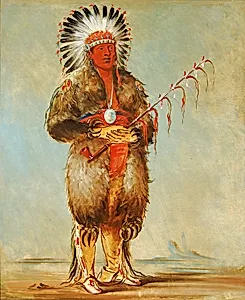
Ráw-no-way-wóh-krah, Loose Pipestem, a Brave
1832
Medium
Painting
Classification
Painting
Department
Smithsonian Collection
Museum
Smithsonian American Art Museum
Credit
Smithsonian American Art Museum, Gift of Mrs. Joseph Harrison, Jr.
Accession Number
1985.66.120
Rights
Public Domain
Tags
About this artwork
George Catlin painted Loose Pipestem’s portrait “full length . . . in a tunic made of the entire skin of a grizzly bear, with a head-dress of war-eagle's quills.” (Catlin, Letters and Notes, vol. 2, no. 34, 1841; reprint 1973)
Art Historical Context
In 1832, American artist George Catlin captured striking portrait of Ráw-no-way-wóh-krah, known as Loose Pipestem, a brave of the Otoe tribe. Catlin, renowned for his Romantic-era paintings documenting Native American life along the Missouri River, created this full-length work during his extensive travels among Plains tribes. As one of 600 portraits in his seminal series, it preserves a moment in Otoe culture just before rapid westward expansion threatened traditional ways of life. The painting depicts Loose Pipestem in a tunic fashioned from the entire skin of a grizzly bear—a bold symbol of courage and prowess, as the bear was revered for its strength. He wears a headdress of war-eagle quills, signifying valor in battle. Catlin's oil technique emphasizes realistic detail and dignified presence, highlighting the subject's regalia without romantic idealization, making it a vital ethnographic record. Housed in the Smithsonian American Art Museum, this portrait underscores Catlin's mission to immortalize Indigenous peoples, offering visitors a window into Otoe heritage and the artist's urgent artistic activism.
About the Artist
George Catlin · 1796–1872
George Catlin (1796–1872), born in Wilkes-Barre, Pennsylvania, to Putnam Catlin and Polly Sutton—who had been captured by Native Americans during the 1778 Battle of Wyoming—initially pursued a legal career. Trained at Litchfield Law School, he was admitted to the bar in 1819 but abandoned law after two years to study art in Philadelphia in 1823. Self-taught as a portraitist, Catlin quickly gained ...