
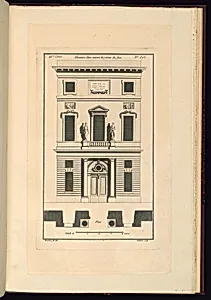
Elevation d'une maison de 7 toises de face
Classification
Department
Smithsonian Collection
Museum
Smithsonian American Art Museum
Credit
Purchased for the Museum by the Advisory Council
Accession Number
1921-6-254-77
Rights
Public Domain
About this artwork
Research in Progress
Art Historical Context
**Elevation d'une maison de toises de face***Juste-François B, French, 1736–1782, ca. 1775* Print; Smithsonian American Art Museum around 1775 by Juste-François B, son of the renowned Rococo François Boucher, this captures an "elevation"—a precise front view—of a house measuring seven toises wide (roughly 45 feet, using the traditional French unit). As an 18th-century architectural rendering, it reflects the elegance of French domestic design during the waning years of the Ancien Régime, blending ornamental detail with functional symmetry. Boucher the younger, trained in his father's artistic milieu, specialized in such prints, which served as models for builders, designers, and patrons aspiring to refined urban or suburban homes. Though the exact medium remains under study (research in progress), prints like this were vital tools in disseminating architectural ideas across Europe. Produced via techniques like etching or engraving, they allowed intricate façades—complete with windows, cornices, and balanced proportions—to be replicated affordably. Acquired by the Smithsonian American Art Museum through its Advisory Council, this work bridges French neoclassical influences with broader transatlantic interests, hinting at how such designs inspired early American architecture. Visitors will appreciate its window into pre-Revolutionary France, where architecture embodied social aspiration and aesthetic harmony. A testament to the Bouchers' enduring legacy, it invites us to envision the grand homes it once helped bring to life.