
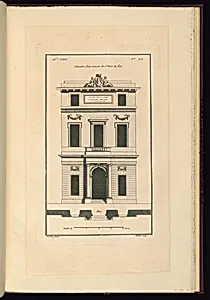
Elevation d'une maison de 6 Toises de face
Classification
Department
Smithsonian Collection
Museum
Smithsonian American Art Museum
Credit
Purchased for the Museum by the Advisory Council
Accession Number
1921-6-254-76
Rights
Public Domain
About this artwork
Research in Progress
Art Historical Context
**Elevation d'une maison de6 Toises de face *Juste-François Boucher, French, 1736–178, ca. 177* *Print; Smithsonian American Art Museum* into the elegant world of 18th-century architecture with this captivating print by Juste-François Boucher son of the renowned Rococo painter François Boucher Titled *Elevation d'une maison de6 Toises de face—meaning "Elevation of a house six toises wide" (roughly 36 feet across)—it presents a precise frontal view of townhouse facade. Created 1775, during the waning years of the Ancien Régime, this work exemplifies the period's fascination with harmonious domestic design, blending Rococo ornamentation with emerging neoclassical restraint. As a print, likely an etching or engraving, Boucher's piece served a practical purpose: architectural elevations like this were essential tools for builders, patrons, and designers, disseminating sophisticated house plans across Europe. Juste-François, trained as an architect and engraver, contributed to this tradition by translating detailed elevations into reproducible art. Though research on this specific work is ongoing, it reflects the Enlightenment-era emphasis on proportion, symmetry, and urban living, offering a window into pre-Revolutionary Parisian aspirations. Housed in the Smithsonian American Art Museum's collection—purchased by the Advisory Council—this rare print invites us to ponder how everyday homes embodied France's artistic legacy. Imagine strolling past such a facade on a cobblestone street; it's a testament to design's enduring charm. (198 words)