
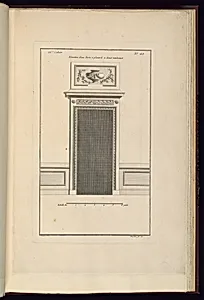
Elevation d'une Porte a placard a deux vanteaux
Classification
Department
Smithsonian Collection
Museum
Smithsonian American Art Museum
Credit
Purchased for the Museum by the Advisory Council
Accession Number
1921-6-253-49
Rights
Public Domain
About this artwork
Research in Progress
Art Historical Context
Juste-François Boucher (1736–1782), son of the renowned Rococo master François Boucher, created *Elevation d'une Porte à Placard à Deux Vantaux* around 1775. This French print depicts a precise architectural elevation of a two-panel wardrobe door, showcasing the ornate decorative designs typical of late 18th-century European furniture making. As a print, it served as a practical pattern or model for artisans, bridging fine art and craftsmanship during France's opulent Louis XVI era. Boucher's work reflects the transition from exuberant Rococo flourishes to more restrained Neoclassical elegance, emphasizing symmetry and refined detailing in domestic interiors. Though the exact medium remains under study, such prints were vital for disseminating sophisticated designs across workshops, influencing cabinetry and interior decoration among the elite. This piece highlights the Boucher family's legacy in ornamental arts, blending artistic innovation with functional utility. Acquired by the Smithsonian American Art Museum through its Advisory Council, the print offers visitors a glimpse into the collaborative world of 18th-century design. Ongoing research promises deeper insights into its techniques and provenance, enriching our understanding of transatlantic artistic exchanges.