
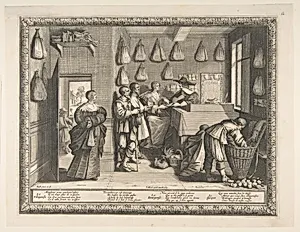
Employment Bureau
Medium
Etching
Dimensions
Sheet: 11 1/8 × 14 1/2 in. (28.3 × 36.9 cm) Plate: 10 3/16 × 13 1/4 in. (25.8 × 33.6 cm)
Classification
Prints
Department
Drawings and Prints
Museum
Metropolitan Museum of Art, New York, NY
Credit
Harris Brisbane Dick Fund, 1926
Accession Number
26.49.57
Rights
Public Domain
Tags
Art Historical Context
Step into the lively world of 17th Paris with *Employment Bureau*, a captivating etching created in 1633 by French artist Abraham Bosse, with engraving assistance from Jean I Leblond. This print, measuring about 11 by 14 inches, offers a detailed interior snapshot of a bustling job agency where men and women gather, perhaps seeking domestic work. Amid the crowd, everyday details abound: baskets of fruit and eggs, live chickens, scattered books, open doors, and windows framing the street outside—elements that paint a vivid picture of urban life during France's early Baroque era. Bosse, a pioneer of realist genre scenes, masterfully captured the social dynamics of Louis XIII's France, where such "bureaus" served as informal employment hubs for servants and laborers. Etching, the medium here, allowed for intricate lines and textures, making complex compositions like this affordable and widely distributable through prints. This technique highlighted the period's growing interest in documenting ordinary people, bridging art and social commentary. Housed in the Metropolitan Museum of Art's Drawings and Prints department (Harris Brisbane Dick Fund, 1926), *Employment Bureau* remains a treasure for understanding pre-industrial labor and domesticity, inviting viewers to ponder the timeless quest for work.
About the Artist
Abraham Bosse|Jean I Leblond · 1602–1676
Abraham Bosse (1604–1676) was a French printmaker and theorist whose approximately 1,600 etchings provide an unparalleled visual record of 17th-century French life. Born to Huguenot parents in Tours, he trained in Paris under Melchior Tavernier and became a devoted follower of Jacques Callot's technical innovations. Bosse's meticulous etchings depicted subjects ranging from daily life and fashion ...