
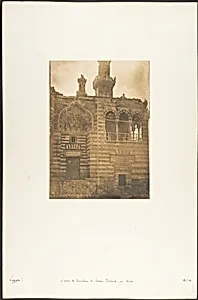
Entrée du Tombeau de Sultan Bezkouk, au Kaire
December 1849–January 1850
Medium
Salted paper print from paper negative
Dimensions
Image: 8 3/4 × 6 5/16 in. (22.3 × 16 cm) Mount: 12 5/16 × 18 11/16 in. (31.2 × 47.5 cm)
Classification
Photographs
Department
Photographs
Museum
Metropolitan Museum of Art, New York, NY
Credit
Gilman Collection, Gift of The Howard Gilman Foundation, 2005
Accession Number
2005.100.376.12
Rights
Public Domain
Tags
Art Historical Context
Step into the sun-drenched necropolis of Cairo with Maxime Du Camp's *Entrée du Tombeau Sultan Bezkouk, Kaire*, a salted paper print captured between December 1849 and 1850. This image frames the grand entrance to the tomb of Sultan Barsbay (also known as Bezkouk a 15th-century Mamluk ruler, nestled in the City's of the Dead. Du Camp, a French writer and pioneering photographer, documented Egypt's architectural wonders during an expedition with his friend Gustave Flaubert, preserving intricate stone carvings and arches that whisper of medieval Islamic splendor. Printed from a paper negative using the calotype process—invented by William Henry Fox Talbot just a decade earlier—this photograph marks one of the earliest efforts to capture the Middle East's heritage through the lens. The soft, textured tones of salted paper evoke a dreamlike quality, contrasting the medium's technical novelty with the timeless majesty of Mamluk design. At 8¾ × 6½ inches, it's an intimate portal to a vanishing world, where photography first rivaled drawing as a tool for exploration. Housed in The Metropolitan Museum of Art's Gilman Collection, this work highlights Du Camp's role in *Orientalism*, blending adventure and artistry to bring Cairo's tombs to global audiences. Imagine Flaubert sketching nearby as Du Camp exposed his plate— a snapshot of 19th-century curiosity meeting ancient legacy.
About the Artist
Maxime Du Camp · 1822–present
Maxime Du Camp (1822–1894) was a pioneering French photographer and writer whose adventurous spirit and technical innovation bridged literature and visual art during the mid-19th century. Born in Paris on February 8, 1822, to a prosperous family—his father a successful surgeon—Du Camp received a solid bourgeois education at the Collège Bourbon (now Lycée Condorcet), where he cultivated interests i...