
Ernest Renan
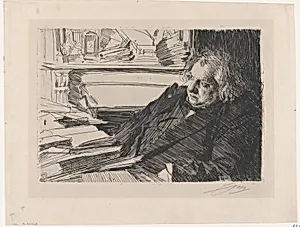
Medium
Etching; fourth state of five
Dimensions
Plate: 8 15/16 × 13 3/8 in. (22.7 × 34 cm) Sheet: 12 3/4 × 16 7/8 in. (32.4 × 42.9 cm)
Classification
Prints
Department
Drawings and Prints
Museum
Metropolitan Museum of Art, New York, NY
Credit
Bequest of Blanche S. Guggenheim, 1953
Accession Number
53.628.2
Rights
Public Domain
Tags
Art Historical Context
In the Prints gallery, behold Anders Zorn's masterful etching *Ernest Renan* (1892), a portrait of the renowned French philosopher and historian. Zorn, a celebrated Swedish artist known for his luminous oils and virtuoso prints, captures Renan with remarkable immediacy in this fourth state of five—a testament to the etching process, where artists progressively refine their copper plates through reworking and proofs. The plate measures 8 15/16 × 13 3/8 inches on a larger sheet, allowing Zorn's delicate lines to evoke texture, expression, and depth. nest Renan (1823–1892), famed for his rationalist *Life of Jesus* and studies of Semitic languages, embodied the era's intellectual ferment between faith and science. Zorn's etching, produced in Renan's final year, immortalizes his contemplative gaze and scholarly aura, blending realism with subtle tonal modulation—a hallmark of Zorn's international style influenced by Impressionism and Whistler. As part of the Metropolitan Museum of Art's collection (Bequest of Blanche S. Guggenheim, 1953), it highlights etching's democratic appeal, making elite portraiture accessible through multiples. This work invites reflection on portraiture's power to humanize history's thinkers, showcasing Zorn's technical brilliance in a medium that bridged painting and printmaking.
About the Artist
Anders Zorn|Ernest Renan · 1860–1920
Anders Zorn (1860–1920), one of Sweden's most celebrated artists, was born on February 18 in Utmeland near Mora in Dalarna, and raised on his maternal grandparents' farm in the nearby hamlet of Yvraden. Displaying prodigious talent from a young age, he attended school in Mora Strand until age twelve, followed by secondary grammar school in Enköping, where he excelled in drawing people and horses. ...