
Ernest Renan
1892
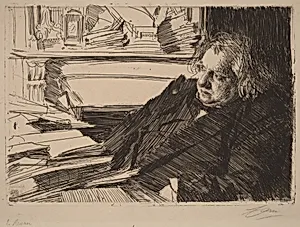
Medium
etching on laid paper
Dimensions
plate: 22.1 × 33.7 cm (8 11/16 × 13 1/4 in.) sheet: 35.6 × 45.9 cm (14 × 18 1/16 in.)
Classification
Department
CG-E
Museum
National Gallery of Art, Washington, D.C.
Credit
Rosenwald Collection
Accession Number
1943.3.8846
Rights
Public Domain
Art Historical Context
Anders Zorn's *Ernest Renan* (1892) is a captivating etching portrait of the eminent French philosopher, historian, and biblical scholar Ernest Renan, whose provocative writings on religion and history stirred European intellectual debates in the late 19th century Swedish artist Zorn, celebrated for his Impressionist-influenced paintings and virtuoso printmaking, created this work during his Paris years, where he mingled with leading cultural figures. The piece reflects the era's fascination with capturing prominent thinkers through intimate, character-revealing likenesses. Executed as an etching on laid paper—a traditional support with visible chain lines that enhances the tactile quality of prints—Zorn employed the intaglio technique masterfully. Acid etched fine lines into a metal plate, allowing for exquisite detail in Renan's expressive face, flowing beard, and contemplative gaze. The plate's modest dimensions (22.1 × 33.7 cm) on a larger sheet (35.6 × 45.9 cm) emphasize the print's precision and the artist's control over tone and texture. Part of the National Gallery of Art's Rosenwald Collection, this print exemplifies Zorn's technical brilliance and his role in elevating etching to fine art status. It invites visitors to appreciate the fusion of portraiture, celebrity, and craftsmanship from fin-de-siècle Europe.
About the Artist
Anders Zorn · 1860–1920
Anders Zorn (1860–1920), one of Sweden's most celebrated artists, was born on February 18 in Utmeland near Mora in Dalarna, and raised on his maternal grandparents' farm in the nearby hamlet of Yvraden. Displaying prodigious talent from a young age, he attended school in Mora Strand until age twelve, followed by secondary grammar school in Enköping, where he excelled in drawing people and horses. ...