
Ernest Renan
1892
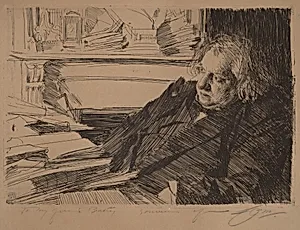
Medium
etching on laid Dutch paper
Dimensions
plate: 23.4 × 33.5 cm (9 3/16 × 13 3/16 in.) sheet: 34.4 × 50 cm (13 9/16 × 19 11/16 in.)
Classification
Department
CG-E
Museum
National Gallery of Art, Washington, D.C.
Credit
Gift of John W. Beatty, Jr.
Accession Number
1964.4.20
Rights
Public Domain
Art Historical Context
Anders Zorn's *Ernest Renan* (1892) is a masterful etching capturing the likeness of the renowned French philosopher and historian Ernestan, whose provocative *Life of Jesus* (1863) challenged traditional religious views and sparked intellectual debates across Europe. Created during Zorn's prolific Paris years, this portrait reflects the late 19th-century fascination capturing the era's luminaries, blending Swedish precision with French elegance. At plate dimensions of 23.4 × 33.5 cm, it showcases Zorn's international acclaim as he bridged Nordic and Impressionist circles. Zorn, a virtuoso printmaker, employed etching on laid Dutch paper—a high-quality, textured support prized for its ability to hold fine ink lines and subtle tonal gradations. His technique masterfully renders Renan's thoughtful gaze and scholarly demeanor through delicate aquatint and drypoint burrs, achieving a luminous, almost painterly realism. This medium allowed Zorn to produce intimate, affordable multiples of elite portraits, democratizing access to celebrity imagery. Housed in the National Gallery of Art's print collection as a gift from John W. Beatty, Jr. (Department CG-E), the work exemplifies Zorn's enduring legacy in graphic arts, inviting visitors to ponder Renan's intellectual legacy through the lens of technical brilliance.
About the Artist
Anders Zorn · 1860–1920
Anders Zorn (1860–1920), one of Sweden's most celebrated artists, was born on February 18 in Utmeland near Mora in Dalarna, and raised on his maternal grandparents' farm in the nearby hamlet of Yvraden. Displaying prodigious talent from a young age, he attended school in Mora Strand until age twelve, followed by secondary grammar school in Enköping, where he excelled in drawing people and horses. ...