
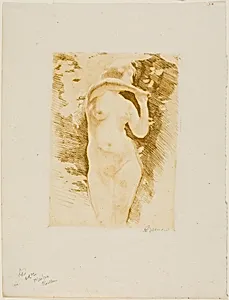
Eve
1896
Medium
Etching and drypoint in bistre ink on ivory laid paper
Dimensions
Image: 17 × 12.3 cm (6 3/4 × 4 7/8 in.); Plate: 18 × 13 cm (7 1/8 × 5 1/8 in.); Sheet: 28.6 × 22 cm (11 5/16 × 8 11/16 in.)
Classification
etching
Department
Prints and Drawings
Museum
Art Institute of Chicago
Accession Number
71905
Rights
Public Domain
Art Historical Context
**Eve** by Albert Besnard (1849–1934), in 1896, is a masterful print from the Art Institute of Chicago's Prints and collection. This intimate etching and drypoint in bistre ink— a warm, earthy brown—graces ivory laid paper, with the image measuring just 17 × 12.3 cm. Besnard, a leading French artist of the fin-de-siècle, was renowned for his technical prowess in printmaking, blending the precision of etching (lines incised by acid on a metal plate) with the soft, velvety texture of drypoint (direct needle scratches that raise a burr for rich tonal depth). The modest scale invites close contemplation, evoking the tactile allure of original prints. Produced during a vibrant era of French Symbolism and emerging Art Nouveau, *Eve* draws on the biblical figure as a symbol of temptation and primal femininity, a recurring motif in late 19th-century art. Besnard's command of ink and paper highlights the medium's democratic potential: prints like this allowed broader access to high art beyond paintings. The laid paper's subtle texture enhances the bistre's subtle glow, underscoring Besnard's innovative approach to light and shadow in black-and-white. A gem for print enthusiasts, it captures the sensual elegance of its time.
About the Artist
Albert Besnard · 1849–1934
Paul-Albert Besnard, known as Albert Besnard, was born on June 2, 1849, in Paris to an artistic family: his father, Louis Adolphe Ferdinand Besnard, was a history painter and pupil of Ingres, while his mother, Marie Louise Pauline Vaillant, was a noted miniaturist trained under Lizinska de Mirbel. Precociously talented, he began his training under Jean-François Brémond before entering the École de...