
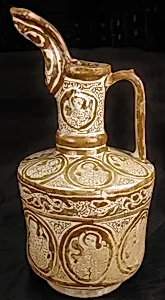
Ewer
Unknown Artist
12th century
Medium
Earthenware; glazed and luster-painted
Dimensions
H. 14 1/4 in. (36.2 cm) Diam. 7 1/4 in. (18.4 cm)
Classification
Ceramics
Department
Islamic Art
Museum
Metropolitan Museum of Art, New York, NY
Credit
Harris Brisbane Dick Fund, 1966
Accession Number
66.175.2
Rights
Public Domain
Tags
Art Historical Context
This exquisite 12th-century e, crafted from earthenware and adorned with glaze and luster-painting, the pinnacle of Islamic ceramic artistry. Standing 14¼ inches tall with a diameter of 7¼ inches, its elegant form—typical of ewers used for pouring water in ablutions or at table—reflects the refined craftsmanship of the medieval Islamic world, likely from Persia or Syria, where such vessels were both functional and luxurious. The luster-painting technique, metallic oxides fired to create a shimmering, iridescent glow, was a guarded secret perfected by artisans in the 9th to 13th centuries. This innovation mimicked costly metalwork, making opulence accessible through clay. The inclusion of human figures in the decoration highlights a vibrant figurative tradition in secular Islamic ceramics, where storytelling motifs flourished despite religious taboos on imagery in sacred spaces. Housed in the Metropolitan Museum of Art's Islamic Art Department (Harris Brisbane Dick Fund, 1966), this ewer invites us to appreciate how everyday objects became canvases for cultural expression, bridging utility and beauty in a golden age of innovation.