
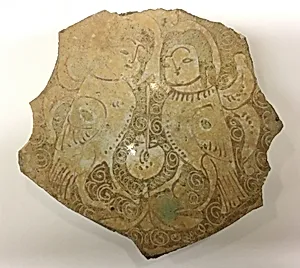
Fragment of a Bowl
Unknown Artist
12th–13th century
Medium
Earthenware; glazed and luster-painted
Dimensions
Ht. 9/16 in. (1.5 cm) W. 3 1/8 in. (7.9 cm)
Classification
Ceramics
Department
Islamic Art
Museum
Metropolitan Museum of Art, New York, NY
Credit
The Grinnell Collection, Bequest of William Milne Grinnell, 1920
Accession Number
20.120.108
Rights
Public Domain
Art Historical Context
This delicate fragment from a bowl, dating to the 12th–13th century, offers a glimpse into the refined world of Islamic ceramics. Crafted from earthenware and adorned with a glossy glaze and luster-painting it once formed part of a larger vessel, likely used for everyday dining or ceremonial purposes in the bustling courts and households of the medieval Islamic world, possibly under Seljuk influence in regions like Iran or Iraq. Lusterware, the standout technique here, was a marvel of its time. Artisans applied metallic oxides over a glazed surface, then fired the piece in a reducing atmosphere to produce a shimmering, iridescent effect that mimicked precious metals or even coveted Chinese porcelain. This innovation, perfected in the Islamic world from the 9th century onward, symbolized luxury and technical mastery, gracing palaces and mosques while influencing ceramics across Europe and Asia. Though small—standing just 9/16 inch high and 3 1/8 inches wide—this shard preserves the elegance of a golden age of pottery. Acquired through The Grinnell Collection and now housed in the Metropolitan Museum of Art's Islamic Art department, it invites us to ponder the anonymous hands that created such beauty amid history's grand tapestry.