
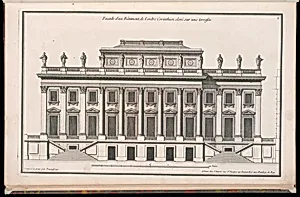
Façade d'un Bâtiment de l'Ordre Corinthien elevé sur une terrasse
Medium
Classification
Department
Smithsonian Collection
Museum
Smithsonian American Art Museum
Credit
Purchased for the Museum by the Advisory Council
Accession Number
1921-6-451-20
Rights
Public Domain
About this artwork
Research in Progress
Art Historical Context
**Façade d'un Bâtiment de l'Ord Corinthien élevé sur une** (1768) is a delicate print by Flemish artist and architect Jean-François de Neufforge (1714–1791). Created during the height of the Enlightenment's fascination with classical antiquity, this work captures the grandeur of a building facade in the Corinthian—one of the most ornate of ancient Greek architectural styles, distinguished by its scrolling acanthus-leaf capitals. Elevated on a terrace, the design evokes idealized symmetry and elevation, blending practicality with aesthetic splendor. As a print from Neufforge's era, it reflects the 18th-century trend of architectural pattern books, which allowed builders and designers across Europe to study and replicate classical motifs. Neufforge, active in France, contributed to this dissemination of neoclassical ideals through precise engravings that prioritized proportion and detail. Housed in the Smithsonian American Art Museum's collection—purchased by the Advisory Council—this piece highlights the transatlantic exchange of artistic ideas, bridging European traditions with emerging American interests in monumental architecture. Though research on this specific print continues, its enduring appeal lies in its role as a window into how 18th-century minds revived antiquity to inspire modern structures, inviting visitors to appreciate the timeless elegance of the Corinthian order. (198 words)