
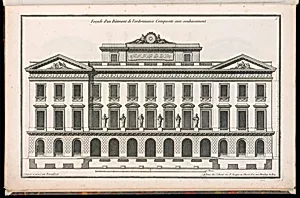
Façade d'un Bâtiment de l'ordonnance Composite avec soubassement
Classification
Department
Smithsonian Collection
Museum
Smithsonian American Art Museum
Credit
Purchased for the Museum by the Advisory Council
Accession Number
1921-6-451-11
Rights
Public Domain
About this artwork
Research in Progress
Art Historical Context
Jean-François de Neufforge, a Flemish architect and engraver (1714–1791), *Façade d'un Bâtiment de l'ordonnance Composite avec souement* in 1768. This intricate print depicts the elegant facade of a building designed in the Composite order—a lavish classical style blending elements of the Ionic and Corinthian orders, topped with a sturdy soubassement (base). Neufforge's work reflects the 18th-century fascination with antiquity, as architects and designers revived Greco-Roman motifs during the Enlightenment. As a print from his era, it likely served as a model for builders and decorators, part of the pattern books that popularized standardized architectural ornamentation across Europe. These affordable reproductions democratized sophisticated design, influencing grand estates, public buildings, and even urban facades amid the rise of neoclassicism. Now in the Smithsonian American Art Museum's collection—purchased by the Advisory Council—this piece highlights transatlantic exchange in architectural ideas. Though research continues, it invites visitors to appreciate the enduring harmony of proportion and detail that defined classical revival.