
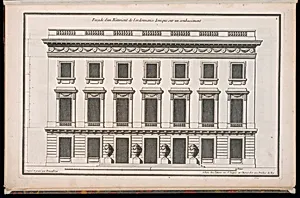
Façade d'un Bâtiment de l'ordonnance Ionique sur un soubassement
Classification
Department
Smithsonian Collection
Museum
Smithsonian American Art Museum
Credit
Purchased for the Museum by the Advisory Council
Accession Number
1921-6-451-8
Rights
Public Domain
About this artwork
Research in Progress
Art Historical Context
Jean-François de Neufforge a Flemish architect and engr (1714–1791), created *Façade d'un Bâtiment de l'onnance Ionique sur un soubassement* in1768. This print the elegant facade of a building designed in the Ionic order—a classical Greek architectural style characterized by slender, scrolled capitals on its columns—raised on a sturdy base or plinth. As part of Neufforge's influential architectural publications, such as his *Recueil élémentaire'architecture*, the work exemplifies the 18th-century fascination with antiquity, blending precise draftsmanship with neoclassical ideals. Produced during the Enlightenment era, when architects across Europe revived ancient Roman and Greek motifs to inspire modern design, this print served as both artistic rendering and practical reference. Neufforge's engravings were prized for their clarity and proportion, aiding builders and designers in replicating harmonious classical forms. The Ionic order, with its graceful volutes, symbolized refinement and was favored for public and residential facades. Now in the Smithsonian American Art Museum's collection—purchased by the Advisory Council—this piece highlights the transatlantic exchange of architectural ideas. Though research continues, it invites visitors to appreciate how prints like this bridged art and engineering, shaping the neoclassical buildings we admire today.