
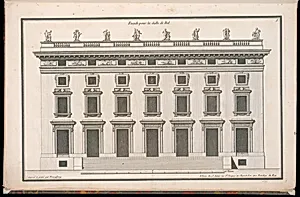
Façade pour la Salle de Bal
Classification
Department
Smithsonian Collection
Museum
Smithsonian American Art Museum
Credit
Purchased for the Museum by the Advisory Council
Accession Number
1921-6-451-5
Rights
Public Domain
About this artwork
Research in Progress
Art Historical Context
**Façade pour la de Bal** Jean-François de Neufforge a Flemish architect and engraver (171–1791), created this elegant print in 1768. Titled *Façade pour la Salle de Bal* ("Facade for the Ballroom"), depicts a refined architectural design likely intended for a grand social space. As a print from the Smithsonian American Art Museum collection, purchased by the Advisory Council, it the intricate engravings that bridged art and architecture during Europe's Enlightenment era. De Neufforge was renowned for his *Recueil élémentaire d'architecture*, a multi-volume pattern book that popularized neoclassical motifs across Europe. Produced amid the shift from ornate Rococo to restrained Neoclassicism, this work captures the opulence of 18th-century ballrooms—spaces for aristocratic revelry—through precise lines and symmetrical compositions. Prints like this were vital tools, allowing architects, builders, and designers to replicate sophisticated facades without direct patronage. Though research continues, this piece highlights the era's fusion of function and festivity, offering a window into how printed designs democratized high-style architecture for palaces and public halls alike. A testament to Neufforge's enduring influence, it invites us to imagine the swirl of dances behind its poised exterior.