
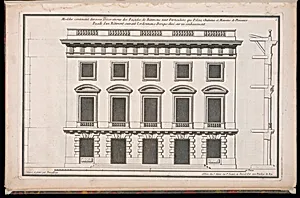
Façade d'un Bâtiment suivant l'ordonnance Dorique élevé sur un soubassement
Classification
Department
Smithsonian Collection
Museum
Smithsonian American Art Museum
Credit
Purchased for the Museum by the Advisory Council
Accession Number
1921-6-451-7
Rights
Public Domain
About this artwork
Research in Progress
Art Historical Context
Jean-François de Neufforge, a Flemish architect and engraver (1714–1791), created *Façade d'un Bâtiment suivant l'ordonnance Dorique élevé sur un soubassement* in 1768. This print depicts a precise architectural elevation of a building facade designed in the Doric order—one of the three classical Greek orders known for its sturdy, fluted columns and simple capitals. Elevated on a solid base, the design exemplifies the neoclassical revival popular in 18th-century Europe, drawing from ancient Roman and Greek precedents to emphasize symmetry, proportion, and grandeur. As part of Neufforge's influential pattern books, such as his *Recueil élémentaire d'architecture*, this work served as a practical template for architects, builders, and designers across Europe. Prints like this democratized classical knowledge during the Enlightenment, allowing the dissemination of refined architectural ideals amid the era's fascination with antiquity. The unknown medium—likely etching or engraving—highlights the technical precision of 18th-century reproductive printmaking, capturing fine details for study and replication. Held in the Smithsonian American Art Museum's collection, purchased by the Advisory Council, this piece underscores the transatlantic exchange of architectural ideas, bridging European traditions with emerging American design influences. Though research continues, it invites visitors to appreciate how such visions shaped the monumental buildings of the time.