
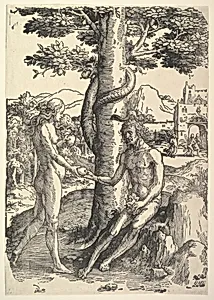
Fall of Man (Adam and Eve)
ca. 1514
Medium
Woodcut
Classification
Prints
Department
Drawings and Prints
Museum
Metropolitan Museum of Art, New York, NY
Credit
Gift of Felix M. Warburg and his family, 1941
Accession Number
41.1.142
Rights
Public Domain
Tags
Art Historical Context
Lucas van Leyden’s *Fall of Man (Adam and Eve)*, created around 1514, captures the pivotal biblical moment when Eve offers Adam the forbidden fruit under the watchful presence of the. As a woodcut print the work belongs to a medium prized during the Northern Renaissance for its bold, reproducible lines that allowed biblical stories to reach wide audiences beyond the walls of churches and palaces. Van Leyden, a Dutch artist celebrated for his detailed printmaking, uses the stark contrasts of the woodcut technique to emphasize the dramatic tension of the scene, with twisting trees and expressive figures drawing viewers into the narrative of temptation and consequence. This print reflects the early sixteenth-century interest in moral instruction through accessible art. Distributed as affordable sheets, such images helped spread religious teachings and humanist ideas across Europe at a time when literacy remained limited. The inclusion of familiar symbols—fruit, serpent, and garden—invites contemplation of human frailty while showcasing van Leyden’s skill in conveying emotion and movement within the constraints of carved wood. Housed in the Metropolitan Museum of Art’s collection of drawings and prints, this work exemplifies how Renaissance printmakers transformed timeless stories into enduring visual lessons for generations of viewers.
About the Artist
Lucas van Leyden · 1484–1533
Lucas van Leyden (1494–1533) was a Dutch painter and printmaker who stands among the greatest engravers of the Northern Renaissance. Born in Leiden as either Lucas Hugensz or Lucas Jacobsz, he lived and worked primarily in his native city, achieving international renown that rivaled the German master Albrecht Dürer. Lucas van Leyden revolutionized Netherlandish printmaking and was among the first...