
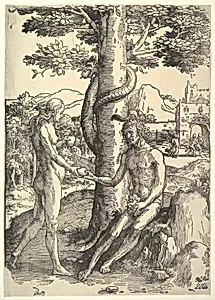
Fall of Man, (Adam and Eve)
ca. 1514
Medium
Woodcut
Dimensions
sheet: 16 3/16 x 11 9/16 in. (41.1 x 29.3 cm)
Classification
Prints
Department
Drawings and Prints
Museum
Metropolitan Museum of Art, New York, NY
Credit
Gift of Harry G. Friedman, 1962
Accession Number
62.635.839
Rights
Public Domain
Tags
Art Historical Context
Behold *Fall of Man (Adam and Eve)*, a captivating woodcut by the Dutch Northern Renaissance master Lucas Leyden, created around 1514. This dramatically captures the biblical moment of temptation in the Garden of Eden, Adam and Eve amid lush trees, forbidden fruit, and the sly serpent—elements that vividly evoke humanity's original sin. Measuring 16 3/16 x 11 9/16 inches, its sheet size allowed for intricate storytelling within a compact format, making it ideal for widespread dissemination during the early 16th century. Lucas van Leyden (1494–1533), a prodigious engraver and painter from Leiden, was renowned for his innovative prints that rivaled the works of Albrecht Dürer. As a woodcut—a relief printing technique where the artist carves into wood blocks to create bold lines and textures—this piece showcases his mastery of contrast and fine detail. Woodcuts were revolutionary for their affordability, enabling biblical narratives to reach everyday viewers across Europe amid the Reformation's rise. Housed in the Metropolitan Museum of Art's Drawings and Prints department (gift of Harry G. Friedman, 1962), this work highlights the era's fusion of faith, artistry, and technology. It invites us to ponder timeless themes of temptation and consequence through van Leyden's precise, evocative lines.
About the Artist
Lucas van Leyden · 1484–1533
Lucas van Leyden (1494–1533) was a Dutch painter and printmaker who stands among the greatest engravers of the Northern Renaissance. Born in Leiden as either Lucas Hugensz or Lucas Jacobsz, he lived and worked primarily in his native city, achieving international renown that rivaled the German master Albrecht Dürer. Lucas van Leyden revolutionized Netherlandish printmaking and was among the first...