
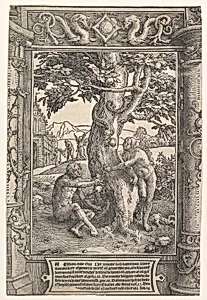
The Fall of Man
ca. 1517
Medium
Woodcut; second state of two
Dimensions
sheet: 13 11/16 x 9 1/4 in. (34.7 x 23.5 cm)
Classification
Prints
Department
Drawings and Prints
Museum
Metropolitan Museum of Art, New York, NY
Credit
Rogers Fund, 1922
Accession Number
22.10.4
Rights
Public Domain
Tags
Art Historical Context
**The Fall of Man**, a striking woodcut by the Dutch Northern Renaissance artist Lucas van Leyden, dates to around 1517. This second state of two captures the biblical moment from Genesis when Adam and Eve succumb to temptation in the Garden of Eden, with the serpent coiled nearby amid lush foliage. Measuring 13 11/16 x 9 1/4 inches, the print exemplifies van Leyden's mastery of intricate detail in a relief printing technique, where the image is carved into a wood block, inked, and pressed onto paper—making it an accessible medium for disseminating religious narratives during the early 16th century. Van Leyden (1494–1533), a prodigy from Leiden often compared to Albrecht Dürer, blended fine line work with dramatic storytelling, influencing printmaking across Europe. Woodcuts like this were revolutionary for their affordability and reproducibility, allowing everyday viewers to contemplate profound themes of sin, temptation, and humanity's fall. The second state likely features refinements to the block, enhancing clarity and depth. Housed in the Metropolitan Museum of Art's Drawings and Prints department (acquired via Rogers Fund, 1922), this work invites us to marvel at how a humble sheet of paper conveyed timeless moral lessons, bridging art and faith in the Renaissance era.
About the Artist
Lucas van Leyden · 1484–1533
Lucas van Leyden (1494–1533) was a Dutch painter and printmaker who stands among the greatest engravers of the Northern Renaissance. Born in Leiden as either Lucas Hugensz or Lucas Jacobsz, he lived and worked primarily in his native city, achieving international renown that rivaled the German master Albrecht Dürer. Lucas van Leyden revolutionized Netherlandish printmaking and was among the first...