
Family
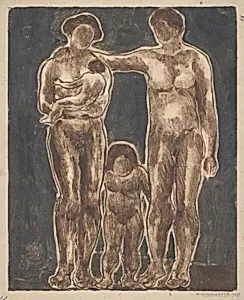
Medium
color monotype on wove paper
Dimensions
image: 25 x 20.1 cm (9 13/16 x 7 15/16 in.) sheet: 28.1 x 23.6 cm (11 1/16 x 9 5/16 in.)
Classification
Department
CG-W
Museum
National Gallery of Art, Washington, D.C.
Credit
Gift of Jacob Kainen
Accession Number
2002.98.357
Rights
Public Domain
Art Historical Context
Abraham Walkowitz's *Family* (1908) is a delicate color monotype on wove, measuring just 25 x 20.1 cm, inviting intimate contemplation. Created during Walkowitz's formative years as a Russian-born American artist immersed in the vibrant modernist scene of Paris, this print captures the warmth of domestic life through fluid, expressive forms. Walkowitz, known for his lyrical depictions of movement and figure—inspired by dancers like Isadora Duncan—here turns his gaze to familial bonds, blending Post-Impressionist influences with emerging abstraction. The monotype technique is key to its charm: ink is brushed onto a smooth plate, and damp paper is pressed once, yielding a unique, painterly image impossible to replicate exactly. This rarity elevates color monotypes as bridges between painting and printmaking, allowing Walkowitz to layer vibrant hues with spontaneous vitality. Produced amid the radical experiments of Fauvism and Cubism, *Family* reflects early 20th-century shifts toward emotional expressiveness over rigid realism. Today, this gem resides in the National Gallery of Art, a gift from collector Jacob Kainen (Department CG-W). It offers visitors a window into modernism's tender side, reminding us how everyday scenes fueled artistic innovation.
About the Artist
Abraham Walkowitz · 1880–1965
Abraham Walkowitz (1878–1965) was a Russian-born American artist who became one of the pioneering figures of modernist abstraction in the United States during the early twentieth century. Born in Tyumen, Siberia, he emigrated to New York as a child and later studied at the National Academy of Design. A transformative period in Paris around 1906–1907 exposed him to the Fauves, Cézanne, and the emer...