
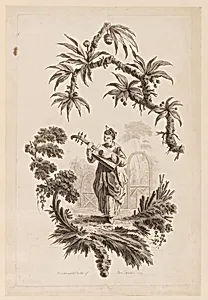
Figure Playing Musical Instrument Under Bough
Classification
Department
Smithsonian Collection
Museum
Smithsonian American Art Museum
Credit
Gift of Eleanor and Sarah Hewitt
Accession Number
1920-36-246
Rights
Public Domain
About this artwork
Research in Progress
Art Historical Context
Jean-Baptiste Pillement, a versatile French artist (1728–1808) active during the lavish Rococo era, created *Figure Playing Musical Instrument Underough* in 1759. Known for his intricate designs in landscapes, floral motifs, and chinoiser-inspired decorations, Pillement traveled widely across Europe, influencing decorative arts from tapestries to porcelain. This print captures the period's delight in pastoral whimsy—a lone figure serenading beneath a tree bough—evoking the lighthearted elegance of 18th-century French taste. As a print, the work reflects Pillement's skill in etching and engraving, techniques he mastered to disseminate ornamental patterns for textiles, wallpapers, and furniture. Rococo prints like this one were prized for their playful asymmetry and natural motifs, bridging fine art and everyday luxury. Though the exact medium remains under study, its classification highlights printmaking's role in democratizing elite designs. Generously gifted to the Smithsonian American Art Museum by Eleanor and Sarah Hewitt—pioneering collectors whose legacy endures at the Cooper Hewitt, Smithsonian Design Museum—this piece invites visitors to ponder music's timeless harmony with nature, a theme Pillement wove into his prolific oeuvre. Research continues to unveil more about its creation and influence.