
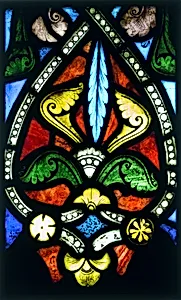
Foliate Border Section
Unknown Artist
ca. 1140–44
Medium
Pot-metal glass, vitreous paint, and lead
Dimensions
12 1/16 × 7 1/2 × 3/8 in. (30.7 × 19 × 0.9 cm)
Classification
Glass-Stained
Culture
French
Department
Medieval Art
Museum
Metropolitan Museum of Art, New York, NY
Credit
Gift of George D. Pratt, 1926
Accession Number
26.218.5
Rights
Public Domain
Art Historical Context
This delicate foliate border section, created in France around 1140–44, represents an early example of medieval stained glass artistry. Crafted from pot-metal glass, vitreous paint, and lead, it likely formed part of a larger window in a church or cathedral during the transition from Romanesque to Gothic styles. Such decorative borders, featuring stylized leaves and vines, framed narrative scenes and added rhythmic elegance to sacred spaces, where light filtering through colored glass was seen as a metaphor for divine illumination. The use of pot-metal glass—molten glass colored with metallic oxides—allowed for rich, translucent hues that remained vibrant over centuries. Artisans painted details with vitreous paint before firing the pieces, then joined them with lead strips for structural integrity. This fragment, now in the Metropolitan Museum of Art’s medieval collection, highlights the technical sophistication of French glass workshops at a pivotal moment when stained glass became central to ecclesiastical architecture. As a gift from George D. Pratt in 1926, the piece offers visitors a tangible connection to the vibrant visual culture of 12th-century France. Its modest scale belies the monumental role such borders played in transforming dimly lit interiors into glowing environments of spiritual wonder.