
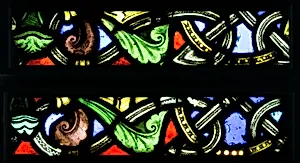
Foliate Border Section
Unknown Artist
ca. 1140–44
Medium
Pot-metal glass, vitreous paint, and lead
Dimensions
a: 3 11/16 × 16 1/16 × 3/8 in. (9.4 × 40.8 × 1 cm) b: 3 7/8 × 16 3/8 × 3/8 in. (9.9 × 41.6 × 1 cm)
Classification
Glass-Stained
Culture
French
Department
Medieval Art
Museum
Metropolitan Museum of Art, New York, NY
Credit
Gift of George D. Pratt, 1926
Accession Number
26.218.6a, b
Rights
Public Domain
Art Historical Context
This exquisite *Foliate Border Section crafted around 1140–44 in France, exemplifies the artistry of early Gothic stained glass Created by an unknown medieval artisan, these delicate panels (measuring about 4 x 16 inches each) feature intricate leafy motifs that once framed larger narrative windows in cathedrals or churches. the 12th century, such decorative borders enhanced the luminous storytelling of biblical scenes, drawing worshippers' eyes upward in a play of colored light symbolizing divine illumination. The medium—pot-metal glass, vitreous paint, and lead—reveals sophisticated techniques of the era. Pot-metal glass, infused with metallic oxides for rich blues, greens, and reds, was cut into shapes and assembled with lead strips for stability. Vitreous paint, fired onto the glass, added fine details like vein-like patterns in the foliage, achieving depth and realism. This method, perfected in French workshops, transformed architecture into glowing jewels, influencing cathedrals like Chartres. Now in the Metropolitan Museum of Art's Medieval Art collection (gift of George D. Pratt, 1926), this fragment invites us to ponder the anonymous genius behind Europe's radiant glass legacy, where nature's motifs bridged earthly beauty and spiritual aspiration.