
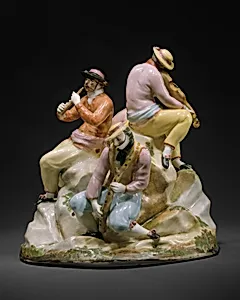
Four carnival musicians
Medium
Soft-paste porcelain
Dimensions
Height: 7 7/8 in. (20 cm)
Classification
Ceramics-Porcelain
Culture
Swiss, Zurich
Department
European Sculpture and Decorative Arts
Museum
Metropolitan Museum of Art, New York, NY
Credit
The Jack and Belle Linsky Collection, 1982
Accession Number
1982.60.277
Rights
Public Domain
Tags
Art Historical Context
In the lively world of 18th-century European porcelain *Four Carnival Musicians* (ca. 1770) stands out as a delightful ensemble from the Zurich Pottery and Porcelain Factory modeled by Joseph Nees. Crafted in soft-paste porcelain refined, creamy material that mimicked Chinese hard-paste but was more affordable and moldable for intricate European designs—these figurines measure about 8 inches tall. Produced in Zurich, Switzerland, a hub of innovative ceramics during the Rococo era, they capture the exuberant spirit of carnival festivities with musicians playing horns, drums, and strings, their colorful attire and animated poses evoking folk merriment. Zurich's factory, active from 1763 to 1782, excelled in whimsical figural groups like this, often hand-painted with vibrant enamels over subtle glazes to highlight details like ruffled costumes and expressive faces. Soft-paste allowed for the delicate modeling of instruments and dynamic groupings, making these pieces prized as table centerpieces for affluent homes. Part of The Jack and Belle Linsky Collection at The Metropolitan Museum of Art, they reflect the cultural fusion of Swiss craftsmanship and pan-European tastes for playful, narrative porcelain that brought music and revelry to everyday life.
About the Artist
Joseph Nees|Zurich Pottery and Porcelain Factory ( |German) · 1758 |1758 –1773 |1824
active 1758–73|German, 1758–1824